Research · Songbird
Zebra finch
Learning reliable motor output
How does the song system’s thalamocortical–basal ganglia circuitry modulate the variability needed for lifelong learning, and keep the network robust?
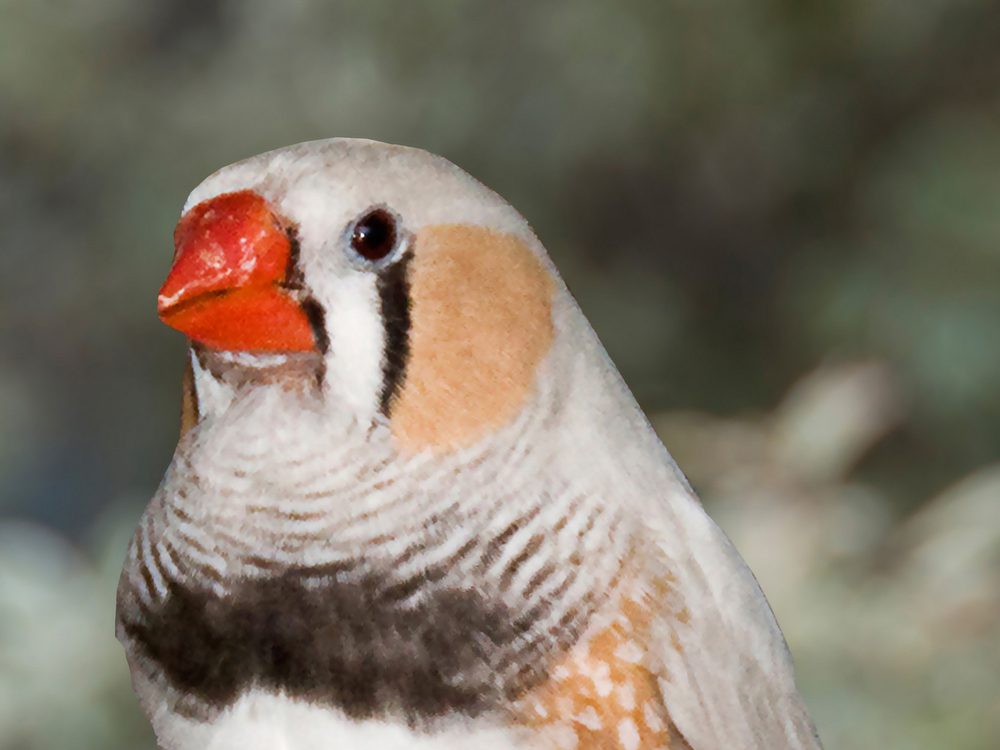
Birdsong has become an excellent testing ground for theories of learning. Young birds learn to sing by trial and error, and adults keep their song stable for life.
In collaboration with the Perkel and Fee labs, we are investigating how the thalamocortical–basal ganglia circuitry of the song system is able to selectively modulate the variability required for lifelong skill learning and maintenance. In collaboration with the Lois and Gardner labs, we are building models to explore how the robustness of the network is maintained.
Selected papers
- Kasdin et al. (2025). Natural behaviour is learned through dopamine-mediated reinforcement. Nature 641, 699–706.
- Wang et al. (2024). Unsupervised restoration of a complex learned behavior after large-scale neuronal perturbation. Nat Neurosci 27, 1176–1186.
- Bell, Duffy & Fairhall (2024). Discovering plasticity rules that organize and maintain neural circuits. NeurIPS 37.
- Duffy et al. (2022). Dopamine neurons evaluate natural fluctuations in performance quality. Cell Reports 38, 110574.
- Duffy et al. (2019). Variation in sequence dynamics improves maintenance of stereotyped behavior in an example from bird song. PNAS 116, 9592–9597.
- Budzillo et al. (2017). Dopaminergic modulation of basal ganglia output through coupled excitation–inhibition. PNAS 114, 5713–5718.