Research · Theory
Single neurons
Adaptive computation in single neurons
What can single neurons compute, and how is this governed by the underlying biophysics?
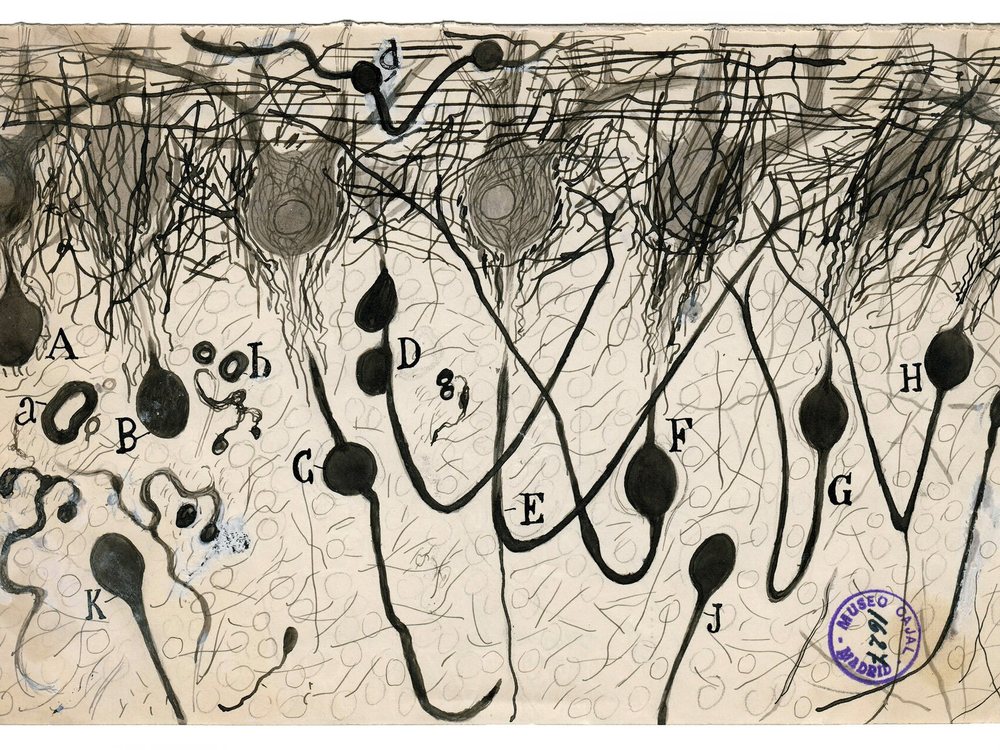
Neural systems are context-sensitive: the encoding of a stimulus depends on the temporal, spatial and semantic context within which it is embedded. In many systems, typical features that are represented adjust according to the signal-to-noise ratio, and the coding range adapts to the typical range of stimuli. What are the rules that govern these processes? What mechanisms support it? How long does adaptation take?
Alongside fast adaptive processes that normalize response functions to the scale of the stimulus, there are slower processes that depend on the history of stimulus statistics. We explore this from several perspectives: finding functional descriptions of the behavior, determining underlying mechanisms, and deriving normative models that may explain it.
We aim to translate complex conductance-based models into functional models that give an intuitive understanding of the input features that drive neuronal responses. We have shown that during development, single neurons acquire the ability to normalize inputs. In collaboration with the Moody lab, we examine how this changes the network’s ability to transmit information on different timescales.
Selected papers
- Weber & Fairhall (2019). The role of adaptation in neural coding. Curr Opin Neurobiol 58, 135–140.
- Weber, Krishnamurthy & Fairhall (2019). Coding principles in adaptation. Annu Rev Vis Sci 5, 427–449.
- Latimer et al. (2019). Multiple timescales account for adaptive responses across sensory cortices. J Neurosci 39, 10019–10033.
- Gjorgjieva et al. (2014). Intrinsic neuronal properties switch the mode of information transmission in networks. PLoS Comput Biol 10, e1003962.
- Mease et al. (2013). Emergence of adaptive computation by single neurons in the developing cortex. J Neurosci 33, 12154–12170.
- Lundstrom et al. (2008). Fractional differentiation by neocortical pyramidal neurons. Nat Neurosci 11, 1335–1342.